

Raw Material Security Through a Circular Economy: Why Germany’s Security Starts with Recycling

The circular economy strengthens Germany’s infrastructure and raw material security. High-quality recycling keeps valuable raw materials in the economic cycle, reduces dependence on imports, and makes supply chains more resilient. At the same time, the IFAT Circularity Monitor shows that while public interest is high, there remains a significant need for information.
Key Points at a Glance
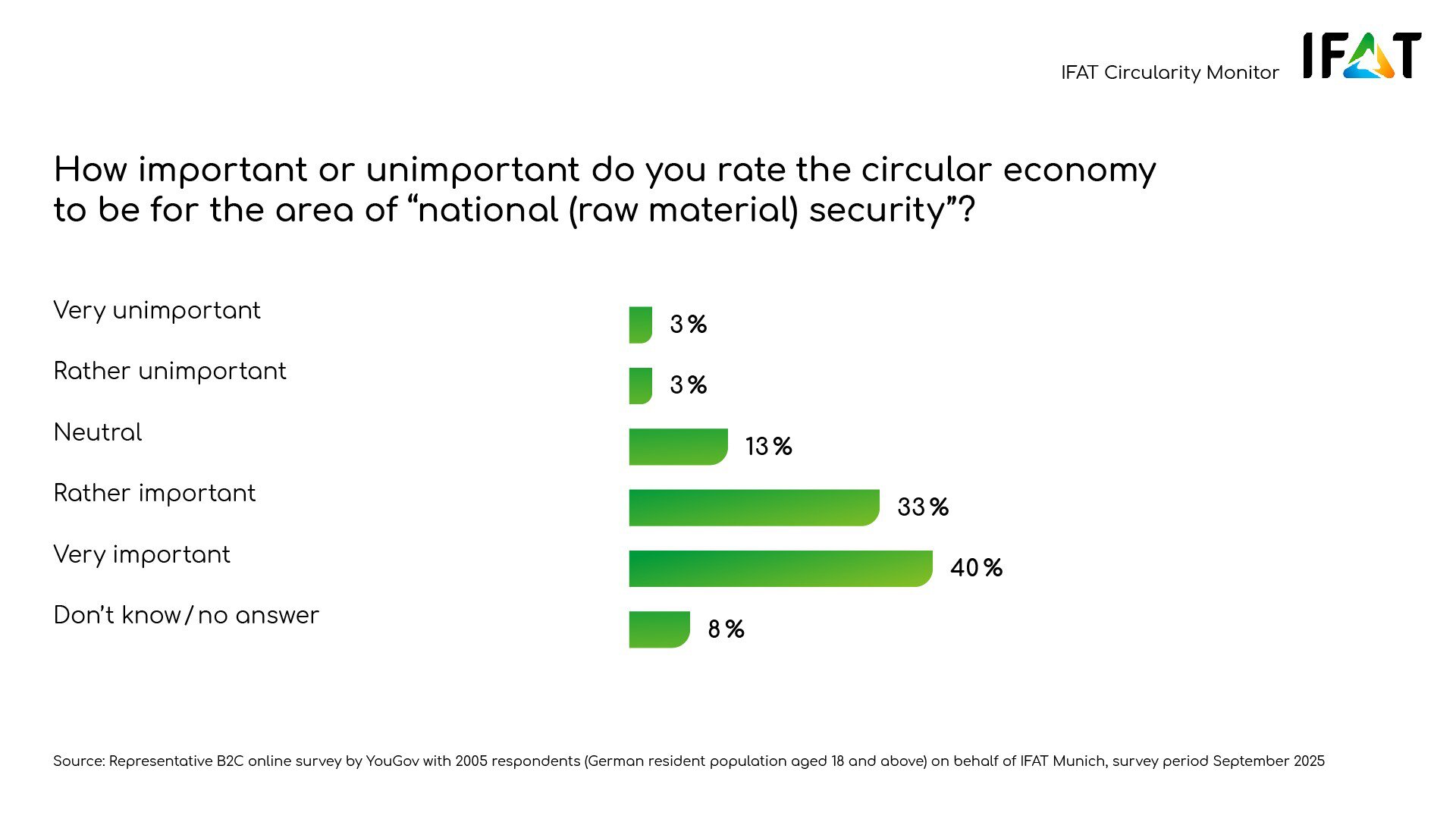
- 73% of the German population views the circular economy as an important contribution to raw material security.
- 83% feel they are only adequately or poorly informed on the topic.
- 57% expect the circular economy to reduce dependence on imports.
- 88% of the corporate decision-makers surveyed see economic opportunities.
- Recycling is evolving from an environmental tool into a building block of economic resilience.
Why the Circular Economy Is a Safety Factor Today
Today, the discussion about the circular economy extends far beyond environmental and climate protection. Geopolitical tensions, volatile commodity markets, and increasing demands for resilient supply chains highlight just how important access to critical raw materials has become. Recycling and the use of secondary raw materials can help companies secure their long-term supply.
What Does “Raw Material Security” Mean?
Raw material security refers to the reliable supply of critical raw materials to the economy and society that is as independent as possible. The more materials are recycled, the less dependence there is on imports.
Why Is Infrastructure Security Important?
Water, waste, and recycling infrastructures are considered critical infrastructures. They ensure the supply of water to the public and industry, and form the foundation of a functioning circular economy.
What Does the IFAT Circularity Monitor Show?
The results of the Circularity Monitor show that public acceptance is high. 73% associate the circular economy with raw material security. At the same time, 83% feel they are not sufficiently informed. 57% see the circular economy as an opportunity to reduce dependence on imports. 88% of corporate decision-makers expect positive economic effects.
See also: Germans Also See Water and Wastewater Networks at Risk
Green Defense: Sustainability as a Resilience Strategy
The term “Green Defense” describes the connection between resource efficiency, economic stability, and supply security. The circular economy helps ensure that critical raw materials remain available for longer, and strengthens the resilience of the economy and infrastructure.
Implications for Businesses
For companies, the circular economy is not just about sustainability. It improves the resilience of supply chains, supports regulatory requirements, and can unlock innovation potential. New business models are emerging, particularly in the water, recycling, and environmental technology sectors.
Conclusion
The circular economy is emerging as a strategic success factor for the economy and society. It combines resource conservation, competitiveness, and supply security. IFAT Munich demonstrates how innovative environmental technologies can help actively shape this transformation.
FAQ
Ensuring a long-term supply of key raw materials while minimizing dependence on imports as much as possible.
Because secondary raw materials remain in the economic cycle and can supplement primary imports.
It brings together businesses, researchers, and policymakers, and showcases solutions in the fields of water, recycling, and environmental technologies.
Learn more: Technological Solutions at IFAT Munich
It supports resilient supply chains, resource efficiency, and competitiveness.