

Cross-Industry Sessions—Ideas that connect Industries
Innovation meets collaboration: The Cross-Industry Sessions are all about interdisciplinary exchange. Experts from different sectors explore new opportunities for sustainability, circular economy and the responsible use of resources.

What are Cross-Industry Sessions?
The Cross-Industry Sessions by IFAT Munich bring together experts from a wide range of industries to collaborate across sectors. Together, they develop new approaches for a functioning circular economy.
Through discussions, panels and events focused on practical topics such as sustainable product design, advanced recycling technologies, and circular business models, participants work toward real-world solutions. Whether held at IFAT Munich itself or in cooperation with partner events like electronica, IAA or ISPO Munich, these sessions spark targeted inspiration, foster valuable connections and broaden perspectives by showcasing best practices from beyond one’s own industry.
Want to stay up to date? Then follow our newsletter on LinkedIn.
Upcoming Events
Performance Days: EPR Textiles - Insights on legislation across the world
- October 14, 2026, 10-10:45 am
- Sustainability Stage
- Participants:
- Moderation: Dr. Tom Vöge, PRO Circularity Alliance
- https://www.performancedays.com/the-fair/program/munich-program.html (more info soon)
electronica: Battery Recycling
- November 11, 2026
- Smart Mobility Stage
- Participants:
- Steffen Hinderer (Senior Director, Crushing & Recycling Technology, BHS Sonthofen GmbH)
- Daniel Reischmann (Technical Sales Engeneer, Liebherr Kreislaufwirtschaft in der Elektromobilität)
Highlights from Previous Sessions
Circular Solutions in Action – Robotics and Disassembly for the Future
May 23, 2025, CIRCULAR REPUBLIC Festival 2025
Key Insights & Takeaways
Automated disassembly is a game-changing lever for the circular economy, from solar panels to e-batteries. Success stories such as SOLAR MATERIALS’ automated line demonstrate economic viability in under two years. AI, digital twins and data-driven processes open new possibilities for precision, material recovery and scalability.
Speakers
Panel: Dr. José Saenz (Fraunhofer IFF), Prof. Dr.-Ing. Tobias Ortmaier (voraus robotik), Fridolin Franke (SOLAR MATERIALS)
Moderator: Rebecca Zhu (Circu Li-ion)
Closing the Loop from the Start – Design as a Key Lever: Integrated Approaches to Make Design-for-Recycling an Industry Standard
June 5, 2025, Day of Circular Economy
Key Insights & Takeaways
True circularity begins at the design stage: without forward-thinking product design, many materials end up in downcycling or waste streams. Harmonized standards, the digital product passport and clear policy frameworks such as the Ecodesign Regulation are essential to make recyclability mandatory. The textiles, packaging, and consumer goods industries need incentives and innovation to ensure high-quality, economically viable use of recycled materials.
Speakers
Panel: Anna Cavazzini (European Parliament), Dr. Susanne Lottermoser (BMUKN), Sibylle Gabler (DIN), Ingeborg Neumann (Gesamtverband textil+mode), Reinhard Schneider (Werner & Mertz), Michael Thews (Bundestag, SPD)
Moderator: Fabian Löhe (SZ Dossier)
A World Without Waste – Is It Possible?
July 1, 2025, SZ Sustainability Summit
Key Insights & Takeaways
Waste is often just a resource in the wrong place at the wrong time, but without a clear regulatory framework, recycling remains economically challenging. The discussion highlighted: design decisions define recyclability, startups are driving innovation, and public procurement can be a major lever for circular solutions. Recyclates must become competitive to achieve a real market breakthrough.
Speakers
Moderator: Kathrin Werner (Süddeutsche Zeitung)
Panel: Dietmar Böhm (PreZero), Thorsten Feldt (Remondis), Susanne Kadner (UnternehmerTUM / Circular Republic), Henning Wilts (Wuppertal Institut)
How Circularity is Reshaping the Future of Mobility
September 12, 2025, IAA Mobility
Key Insights & Takeaways
The future of mobility depends on circular economy solutions: secondary metals such as aluminum or steel can save up to 95% of energy, recycling is indispensable for batteries, and digital product passports create transparency. Politics and industry must accelerate efforts, only with clear regulations, intelligent design, and digital tools can Europe remain competitive.
Speakers
Panel: Bernd Fleschenberg (TSR Group), Michael Püschner (VDA)
Moderator: Dirk Böttner-Langolf (BDE)
More Insights from our Session at IAA Mobility
Green Defense: Why the circular economy is becoming a security issue
November 18, 2025, SZ Wirtschaftsgipfel (Economic Summit)
Key insights & Takeaways
Raw material dependency is no longer purely an economic issue, but a question of security and geopolitical resilience. With import dependency at over 90 percent, it is clear that the circular economy is a strategic tool for stabilizing supply chains, minimizing risk for companies, and strengthening European sovereignty. The circular economy reduces vulnerabilities, promotes innovation, and broadens the security policy perspective beyond traditional trade strategies. The discussion made it clear that green defense begins with the material cycle.
Speakers
Panel: Anja Siegesmund (BDE), Wolfgang Ischinger, Philipp Eisenmann (IFAT Munich)
EPR and textiles: Why regulation is becoming a competitive advantage
December 18, 2025, ISPO 2025
Key insights & Takeaways
Extended producer responsibility (EPR) represents a significant shift in the textile and sporting goods industry. The decisive factors are the early adaptation of design, data, and partnerships, not the amount of potential fees. Products that are recyclable and durable reduce costs and risks. Digital product information is becoming a prerequisite for compliance. Without new collaborations along the entire value chain, textile recycling cannot be scaled. The key message is: Those who start now will secure regulatory capacity and strategic advantages.
Speakers
Panel: Angelique Thummerer (TURNS), Bastian Lankeit (Schwarz Group Corporate Affairs GmbH & Co. KG),Marie Nawrocki (Decathlon)
Moderator: Carina Hofmann-Wellenhof (CIRCULAR REPUBLIC)
From Circular Design to Circular Vehicles – How the Circular Economy Is Changing the Future of Mobility
May 4, 2026, IFAT Munich 2026
Key insights & Takeaways
The session focused on the interaction between vehicle engineering, material loops and regulatory requirements, as well as the implementation of circular economy principles across the automotive value chain.
Speakers
Panel: Hildegard Müller (President, VDA), Bernd Fleschenberg (COO, TSR), Dr. Johannes Kirchhoff (Chairman of the Executive Board, KIRCHHOFF Ecotec SE), Christian Wilz (Chairman of the Management Board, Mercedes-Benz Trucks Germany)
Keynote: Matthias Harms (President, BDE)
Moderator: Caspar Dohmen (Head of Editorial, ESG.Table)
Cross Industry with IAA MOBILITY: Battery Recycling in the Automotive Industry
May 7, 2026, IFAT Munich 2026
Key insights & Takeaways
The session explored technological approaches, regulatory frameworks and economic challenges in traction-battery recycling. It focused on how efficient recycling can contribute to raw-material security, decarbonisation and a functioning circular economy in the automotive sector.
Speakers
Karol W. Bednarek (Policy Officer, Raw Materials Policy and Markets, VDA), Jonathan Laufer (Product Management, BASF Battery Materials)
Circular Republic Festival
Day of Circular Economy
SZ Sustainability Summit
IAA Mobility
 Play video
 Play video
 Play video
 Play video
Newsletter: Circularity with Global Impact
Currently, only 6.9% of all resources used worldwide are utilized in a circular manner—representing an enormous untapped potential. To change this, cross-sector thinking, new alliances and concrete solutions are essential. This is exactly where IFAT Munich's Cross-Industry Sessions come in as a platform for exchange, innovation, and transformation.
The newsletter Circularity with Global Impact is more than just a companion to individual Cross-Industry Sessions. It is becoming the central communication platform for all things circular economy across industries, disciplines and events. In regular editions, we will compile key insights, discussions and solution approaches from IFAT Munich’s own formats, as well as from leading partner events such as ISPO Munich, electronica and the Circular Republic Festival.
What you can expect:
- Interviews with speakers from business, academia, startups and politics
- Deep dives into key topics such as eco-design, circular systems, regulatory developments, and business models
- Exclusive insights and learnings from the Cross-Industry Sessions and partner formats (including ISPO Munich, electronica, Circular Republic Festival)
Why cross-industry exchange matters
- Industries can learn from each other (e.g. design principles from IT for the packaging industry)
- New partnerships often arise at intersections
- Experts share practical insights and real-world experiences
- Inspiration for your own solutions and strategies
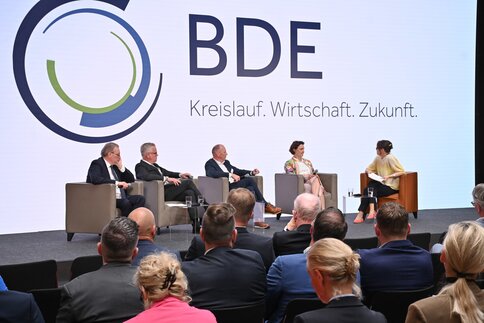
Key takeaways for companies from the previous Cross-Industry Sessions
- Prepare for EPR (Extended Producer Responsibility): Adapt to new legal product responsibility requirements.
- Implement eco-design: Create durable, repairable and recyclable products to avoid future fees and penalties.
- Launch take-back programs: Close material loops in textiles, electronics and outdoor gear.
- Partner with logistics providers: Ensure efficient sorting and recycling.
- Start with eco-design and product analysis.
- Review product portfolios: Use mono-materials where possible.
- Adopt design for recycling: Avoid complex composites and coatings.
- Promote recycled materials: Integrate recyclates into new products.
- Introduce data management and transparency systems.
- Conduct life cycle assessments (LCA): Identify environmental hotspots and drive improvements.
- Prepare for Digital Product Passports: Track material, production, and end-of-life data.
- Test pilot projects for new business models
- Experiment with repair services, second life and leasing models.
- Partner with startups and tech providers to shorten innovation cycles.
- Scale successful pilots.
- Proactively seek Cross-Industry collaboration.
- Build Networks: Connect with experts in environmental technology, design, recycling and policy.
- Share Best Practices: Open knowledge sharing accelerates system change.
- Start Small: Use pilot projects to gain insights and unlock innovation early.
- Learn from Mistakes: Agility is key to successful transformation.