

From smart sorting to fiber-to-fiber: 3 innovative approaches to textile recycling

Overproduction and short product life cycles place a strain on both the environment and resources. At the same time, the demand for high-quality recycling solutions is growing rapidly. Three practical examples show how digital sorting systems, new process chains, and modern recycling methods are paving the way for true circularity.
Just a few figures suffice to outline the scale of the challenge:
- According to a recent report by the European Environment Agency (EEA), the 27 EU member states generated almost seven million tons of textile waste in 2022.
- That equates to a good 16 kilograms per person—and consumption continues to rise.
- In contrast, less than half of the used clothing generated in the EU is collected for reuse or recycling.
- Only one percent is recycled into new clothing.
Textile recycling—a key topic at IFAT Munich 2026
What is needed to put an end to this environmentally damaging waste of resources? How can high-quality textile recycling be organized and implemented from a technical perspective? IFAT Munich 2026 will address these and other questions. From May 4 to 7, the world's leading trade fair for environmental technologies will dedicate two spotlight areas to various aspects of textile recycling. The special areas will be supported by the German Engineering Federation (VDMA) and the Federal Association of the German Waste Management, Water and Recycling Industry (BDE) in cooperation with the German Textile and Fashion Association. In addition, the topic will be a focus of the Orange Stage on May 6, 2026.
As a preview, we present three approaches for greater circularity in the textile industry.
TURNS: Circular old clothing management as a service
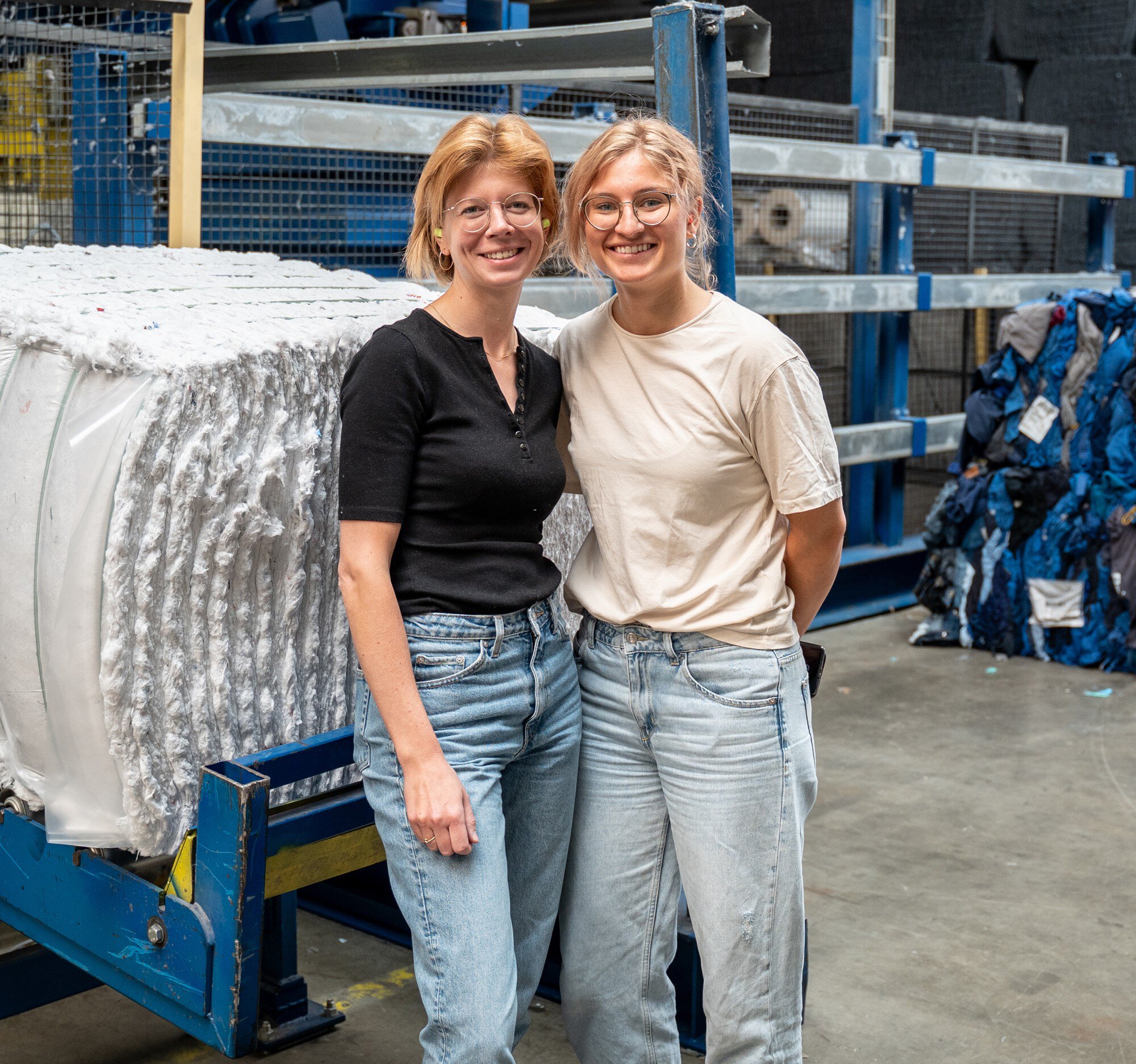
The company TURNS circular systems offers a comprehensive, digitally controlled management system that connects all players along the textile value chain. “As a strategic partner, we enable companies to implement closed-loop industrial solutions—from collection and sorting to recycling and the use of recycled fibers in new textile products,” explains Katja Wagner. The textile business economist founded TURNS together with IT specialist Angelique Thummerer in Ansbach in 2023.
Focus on workwear
The founders' core target group currently consists of companies that provide employee clothing and manufacturers of workwear. “These companies generate large, homogeneous quantities of textiles and clothing, which are currently thermally recycled for data protection reason—favorable conditions for establishing a recycling cycle,” explains Angelique Thummerer. There are also plans to expand the customer base to include textile distributors, sorting companies, recyclers, and textile manufacturers.
To enter the fiber cycle, companies register the used textiles they have collected in the TURNS online hub and pay a feed-in fee per kilogram, which is the main financial driver of the system. Customers can track the route and process status of their materials via the internet platform. This is linked to legally compliant documentation.
In the next step, freight forwarders deliver the input material to three cooperating, decentralized sorting stations in social institutions. “We have developed an app that allows us to digitally transmit our sorting criteria and order details to the manually operating sorting companies,” says Thummerer. Parallel to visual and manual sorting, near-infrared technology is used to analyze the material according to fiber, color, and quality, which helps to assign the used textiles to their further recycling path
Fiber-to-fiber recycling is characterized by the fact that every fiber can be reused. In addition, the process does not require any water or chemicals.
Chemical-free fiber-to-fiber recycling
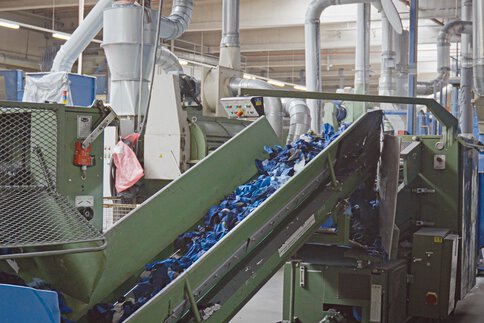
For recycling, the sorted garments, pressed into bales, are delivered to four specialized companies in Europe. There they are cut up and torn apart. Machines with fine needles then gently remove the fibers from the existing fabric structure. "Fiber-to-fiber recycling is characterized by the fact that every fiber can be reused and its structure remains intact. What's more, the process requires no water or chemicals," explains Wagner. According to her, both monomaterials and mixed fibers can be recycled, with single-material goods, such as those made from 100 percent cotton, being particularly easy to process.
The recovered high-quality fibers are mixed with fresh fibers in spinning mills and spun into new yarn. TURNS works with five partner companies in Europe and Asia. The yarns produced there usually consist of 10 to 30 percent recycled fibers, with the rest being fresh fibers. According to Katja Wagner, higher recycling rates are technically possible, but they lead to a loss of quality.
Industrial companies and fashion brands can purchase materials from the fiber cycle, such as yarns, fabrics, or finished textiles, and use them to develop individual products. To date, the TURNS fiber cycle has recycled over 170 tons of old clothes and produced more than 115,000 new textile products from recycled fibers.
One of the early users of the TURNS system is workwear manufacturer HAKRO. Recycled fibers are extracted from its end-of-life workwear, which HAKRO then uses to produce leisurewear and market as its own product line under the name Hello again.
Looper Textile Co.: Trade and recycling industry join forces
The international fashion company H&M and the German environmental services provider REMONDIS founded Looper Textile Co. in 2023. The joint venture aims to ensure that as many textiles as possible are given a new lease of life by collecting, sorting, and forwarding discarded garments for reuse or recycling.
Looper Textile Co. is headquartered in Stockholm and has two sorting facilities in Germany—in Hamburg and Polch—and one in Piła, Poland. Together, they have a capacity of up to 50 million garments per year. After 40 million in 2023, more than 72 million old clothes were processed last year in collaboration with other sorting partners worldwide.
The lion's share of this came from Europe, mainly from retail take-back systems. For example, customers can drop off their clean textiles of any brand that they no longer need in recycling boxes provided in all H&M stores worldwide.
The majority goes into resale
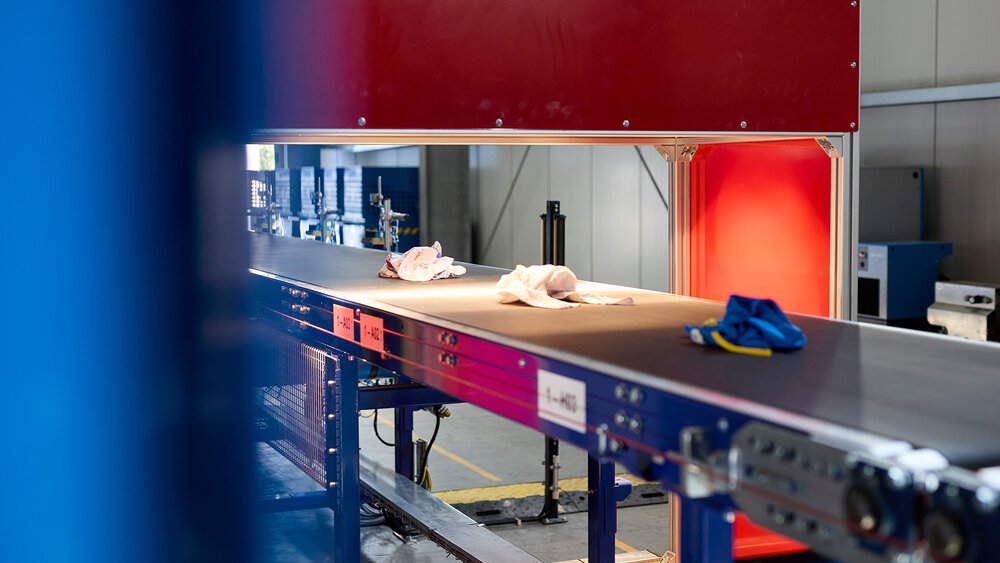
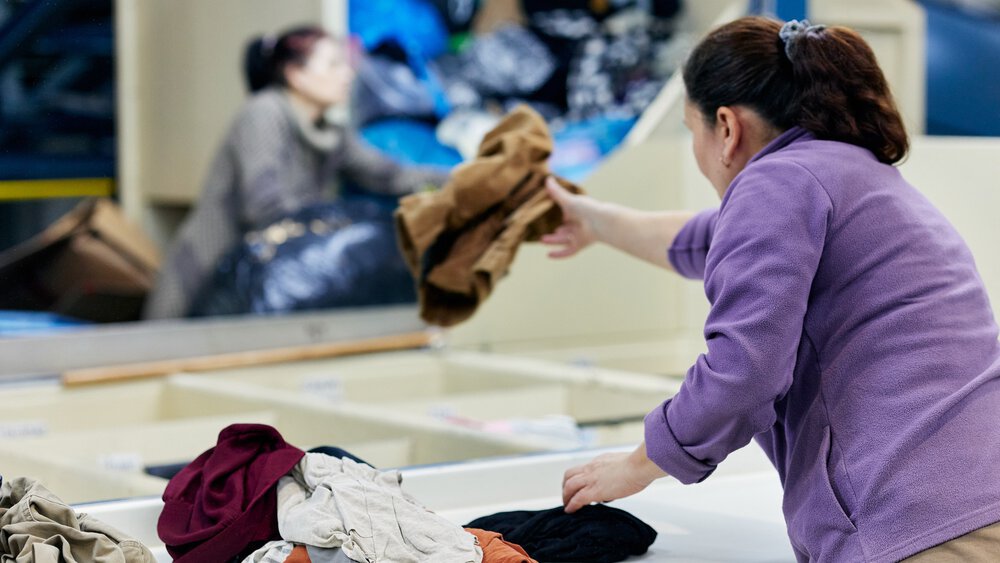
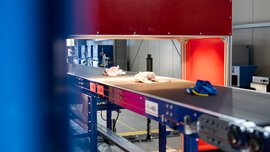
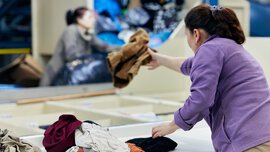
At the sorting facilities, each item is checked manually and visually to determine its quality, condition, and resale potential. Garments that can be returned to the cycle as second-hand clothing are sorted into more than 200 categories. “This maximizes the likelihood that the items will reach suitable customers in their next life cycle,” explains Erik Lagerblad, CEO of Looper Textile Co. In 2024, 65 percent of his company's input fell into the “resale” category. Important sales markets for second-hand goods were Pakistan, Ivory Coast, Bosnia, and Romania. Twenty-five percent of the used clothing collected was no longer suitable for resale and was processed into textile cleaning cloths or insulation material, for example.
Around two percent textile-to-textile
In 2024, Looper Textile Co. was only able to recycle a small percentage of around two percent of discarded clothing into new textiles. The mechanical fiber-to-fiber recycling required for this was carried out by various industrial partners in Hungary, Poland, the Netherlands, and other countries. However, Looper sees great potential for increasing this percentage in the future. In 2024, for example, the H&M Group teamed up with the investment firm Vargas Holding to found the recycling company Syre, which aims to recover polyester from old textiles for use in new fabrics on an international scale.
There is also room for improvement in the sorting of textiles. To this end, Looper operates a pilot sorting line at its Polch site that uses optical and near-infrared sensor technologies. Despite all efforts to reuse and recycle, around ten percent of the input could not be assigned to any of the above categories due to massive contamination and was thermally recycled.
EPR in Sports: From Obligation to Opportunity
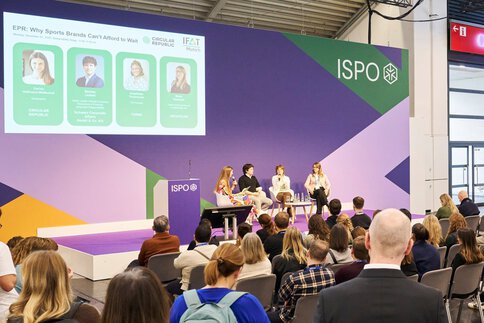
At the IFAT Munich Cross-Industry Session at ISPO 2025, experts explored how Extended Producer Responsibility (EPR) is set to transform the textile industry. These are the key learnings:
- EPR is a system change, not a surcharge.
- Start now, the transition cannot be done overnight.
- Design and data will determine your EPR performance.
- Scaling textile recycling requires new partnerships.
- Data is the new compliance currency.
Want the full insights? Read more in our latest LinkedIn newsletter.
Schöffel: Recyclable thanks to mono-material concept
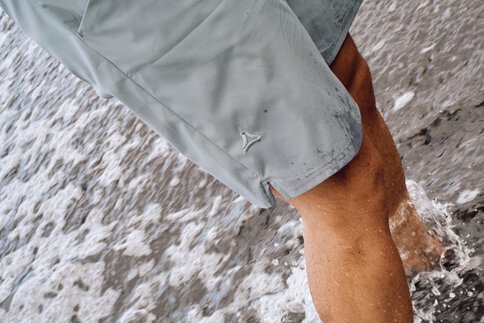
Clothing items are usually made from a variety of different materials. This complex composition has been a major challenge in the recycling process to date. German outdoor clothing company Schöffel has been countering this with its “Circularity” collection since 2023. The so-called CIRC line consistently relies on polyester as its material. Thanks to this mono-material concept, the shirts, jackets, and pants can be recycled with virtually no loss after use and processed into new garments.
Chemical recycling at matterr
The cycle begins with an invitation to customers to return their CIRC product to Schöffel free of charge at the end of its useful life. After a multi-stage visual and functional inspection, the used textiles are handed over to recycling partner matterr. The Lower Saxony-based start-up has developed a process that converts polyester into monomers. These are then available again for the production of new-quality products—yarn is turned back into new yarn. This chemical recycling is currently still taking place in a pilot plant in Braunschweig. Construction of an industrial-scale plant is scheduled to begin in 2026.
“To finance the recycling, Schöffel and matterr have a contractually regulated purchase agreement in which we pay per kilogram of material delivered,” explains Marco Tenace. The Director of Operations in Schöffel's Sports segment continues: “However, the return volume is still quite small and irregular at present, as the CIRC program was only launched two years ago and most of the products are still in use due to their high quality and durability.” However, the return volume is expected to increase steadily in the coming years. “In order to make CIRC even more comprehensive in the future, we are expanding our concept and developing projects to cover sustainable solutions in all phases of the circular economy. This includes, for example, new products such as bags made from old Schöffel materials,” announces Tenace.
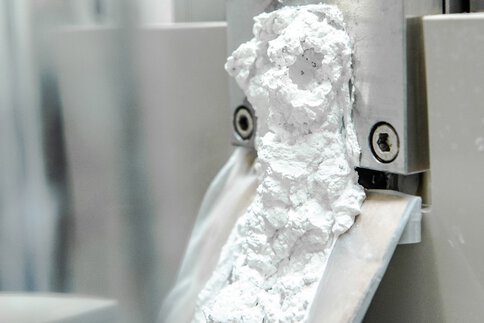
matterr at the Startup Area of IFAT Munich
The Braunschweig-based textile recycling pioneers from matterr are one of an estimated 50 startups that will be presenting themselves in the Startup Area at IFAT Munich in May 2026.
Get more information for interested exhibitors and visitors.
From 2027, with at least 50 percent recycled polyester
The recycled polyester produced during the processing of CIRC products and other feedstock is freely available on the market. In the long term, the material will also be fed back into Schöffel's production process. “Our product team is instructed to use recycled fibers whenever possible,” emphasizes Tenace. Starting with the 2027 summer collection, a mandatory minimum content of 50 percent recycled polyester will be introduced for all CIRC garments.
In the Schöffel 2026 summer collection, CIRC models account for almost 14 percent of the total. While plastic zippers and silicone prints can be easily recycled, there are still barriers when it comes to nylon fabrics, acrylic prints, patches, animal components such as down and wool, and metal zippers and buttons.
The clothing company has set itself the goal of reducing the remaining restrictions in the coming years and, in particular, expanding its fiber portfolio. In the near future, the use of nylon fiber, which together with polyester is one of the most important components of Schöffel products, is to be made possible.
Towards a more circular economy with sustainable solutions
Innovative thinking, new technologies, and strong partnerships: The examples presented here show that various players can gradually develop textile value chains toward circularity using different approaches. In addition to the will to change, it is crucial that practical solutions are developed throughout the entire process that meet both ecological and economic requirements.