

60 years of IFAT – 60 milestones in the environmental industry

IFAT has been supporting and inspiring environmental technology for 60 years. To mark this anniversary, we invite you to join us on a journey through six decades of innovations, milestones, and visionary ideas that have shaped the industry and made the world a little more sustainable.
1966 – The beginning: Wastewater technology takes center stage
The first International Trade Fair for Wastewater Technology (Internationale Fachmesse für Abwassertechnik) takes place from September 5 to 9. The German name is abbreviated to IFAT, which is still used as the brand name today. The new trade fair is initiated by the Abwassertechnische Vereinigung (Wastewater Technology Association—ATV). The venue is the exhibition center in Munich’s Schwanthalerhöhe district, which borders Theresienwiese to the east. This serves as a parking lot for the 10,200 trade fair visitors from 40 countries.
1967 – Disasters raise awareness
Major tanker disasters, such as the Torrey Canyon oil spill off the coast of southern England, attract international environmental attention; they are considered catalysts for the modern environmental movement and organizations such as Greenpeace.
1968 – Systematically combating noise
- In Germany, the “Technical Instructions on Noise Protection” (TA Lärm) are published. The regulation makes noise protection systematically measurable, comparable, and enforceable by authorities for the first time.
- Finnigan Instruments (USA) delivers the first commercial GC-MS systems. The combination of chromatography and mass spectrometry quickly becomes the standard for pesticide and dioxin analysis.
1969 – A fiery wake-up call
- On June 22, a thick layer of oil, industrial waste, and chemicals ignites on the surface of the Cuyahoga River in Cleveland (USA). The burning river influences water policy worldwide.
- The second IFAT is taking place at the exhibition center in Munich.
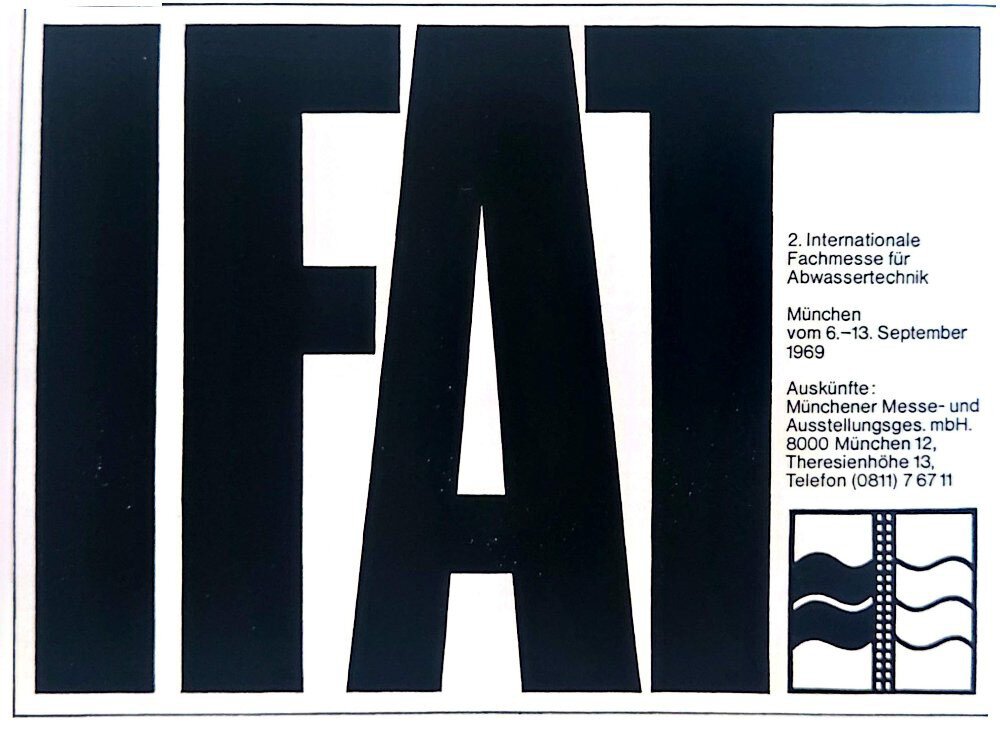
1970 – Founding of the EPA
- The Environmental Protection Agency (EPA) is founded in the USA. It enforces binding emission standards for the first time and massively accelerates the market introduction of new technologies.
- In Germany, the Bavarian State Ministry of Regional Development and Environmental Issues—now the Bavarian State Ministry of the Environment and Consumer Protection—is launched as the world’s first environmental ministry.
1971 – Environmental policy becomes official across Germany
The German federal government’s first environmental program is adopted on October 14. It systematically defines environmental policy as a task based on precautionary principle as well as the polluter–pays principle.
1972 – Waste at IFAT
- The first United Nations Conference on the Human Environment —takes place in Stockholm. It is considered a historic turning point in international environmental policy and led, among other things, to the later establishment of the United Nations Environment Programme (UNEP).
- The topic of waste disposal is included in the IFAT exhibition and symposium program for the first time.
1973 -– Oil crisis
On October 17, the price of oil rises by 70 percent from around USD 3 per barrel to over USD 5. Environmental and energy technologies begin to converge. For German politicians, the issue of “security of supply” comes to the fore.
1974 – Not letting used glass go to waste
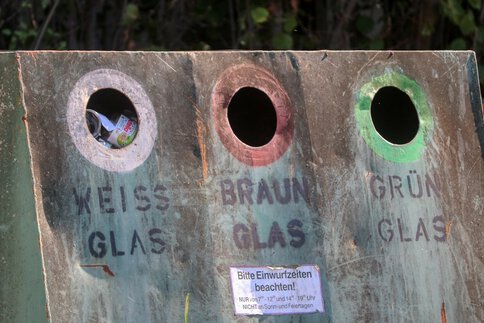
- Hanover is the first city in West Germany to introduce glass recycling containers. This marks the start of what is now a nationwide glass recycling collection system in Germany.
- The Federal Immission Control Act is passed.
1975 – IFAT in European spheres
- The EU Waste Framework Directive and the German Waste Management Act come into force under the principle that “waste is a design flaw.” This corresponds to the well-known cradle-to-cradle principle.
- At IFAT, the combination of the trade fair with the European Wastewater and Waste Symposium proves its worth.
1976 – Boost for sewage treatment plants
The Waste Water Charges Act comes into force in Germany. It regulates the obligation to pay a charge for discharging wastewater into water bodies, thereby creating an economic incentive to expand municipal wastewater treatment plants.
1977 – Nature conservation becomes law
The Federal Nature Conservation Act comes into force in Germany.
Celebrate 60 years of IFAT with us!
On May 6, starting at 17:00, we will welcome exhibitors and visitors in the East Entrance. Celebrate the IFAT anniversary with us with free drinks and beats!
1978 – Results, not regrets
At IFAT, a complete range of products and services for urban cleaning is presented for the first time, following the decision by the Verband Kommunaler Städtereinigungsbetrieb (Association of Municipal Cleaning Companies—VKS) to combine its previous traveling exhibitions with the Munich trade fair.
1979 – Geneva and Harrisburg
- The first World Climate Conference (WCC-1) takes place in Geneva, Switzerland.
- The accident at the Three Mile Island nuclear power plant near Harrisburg is the most serious incident in the history of commercial nuclear power in the United States.
1980 – Flue gas desulfurization
The first large-scale wet flue gas desulfurization plant (FGD) to be used in a West German coal-fired power plant goes into operation at the Scholven power plant (North Rhine-Westphalia). The German large-scale plant manufacturer Lurgi plays a key role in this project.
1981 IFAT takes to the streets
At IFAT, road and winter services for cities and municipalities are added as exhibition topics.
On video: 60 years of circularity
Join us on a short cinematic journey through 60 years of IFAT—and 60 years of circularity.
1982 – The GDR conceals environmental data
On November 16, the Presidium of the Council of Ministers of East Germany issues the “Order on the Collection, Processing, and Protection of Information on the State of the Natural Environment in the GDR,” which places environmental data under lock and key.
1983 – Look up in the sky!
- The German government publishes official figures on forest dieback for the first time. Technical solutions such as desulfurization plants in coal-fired power stations and the introduction of unleaded gasoline become increasingly important.
- The German Regulation on Large Combustion Plants comes into force.
- The environmental toxins PCB and dioxin, as well as the “summer smog” caused by road traffic, come into the spotlight.
1984 – Emissions and innovations
- The new EU Industrial Emissions Directive requires plant operators to use the best available techniques to minimize emissions of pollutants into the air and water.
- The chemical disaster in Bhopal (India) leads to stricter safety checks in European chemical parks and the further development of early warning systems and retention basins for pollutants.
- PRECO (Uchte) presents the first plastic manhole base at IFAT. This innovation lays the foundation for modern, jointless, and corrosion-resistant sewer systems.
1985 – Poor air quality causes concern
On January 18, the highest-level smog alert is declared for the first time in the Ruhr region. In response, special emissions testing is introduced for all vehicles with gasoline engines. This leads to the rapid spread of three-way catalytic converters.
1986 – Chernobyl & Sandoz
- The Chernobyl nuclear disaster occurs on April 26 at the Chernobyl nuclear power station (Ukraine). As one of the consequences, German Chancellor Helmut Kohl establishes the Ministry of the Environment in Bonn in June. Walter Wallmann is the first Minister of the Environment.
- In November, following a major fire at the Sandoz chemical plant near Basel, Switzerland, 20 tons of toxic firefighting foam flowed unhindered into the Rhine, resulting in the death of a huge quantity of fish. In light of the disaster, safety standards of industrial plants are improved and combined with effective monitoring.
1987 – A committed minister
In Germany, Klaus Töpfer becomes the new Federal Minister for the Environment. He initiates far-reaching developments such as the phase-out of CFC production, the end of thin acid dumping in the North Sea, and the reduction of dust emissions. In May 1988, he jumps into the Rhine near Mainz to demonstrate the river’s restored cleanliness following the Sandoz chemical accident in 1986. This famous act helped to bring environmental protection to the forefront of social debate in the 1980s.
1988 – Germany leads the way in thermal waste utilization
Germany is an international leader in direct energy recovery from waste: Around 98% of incinerated waste is processed in plants that recover heat. In the European Community, the figure is only 15%.
1989 – Oil spill with constructive consequences
The Exxon Valdez oil spill (Alaska) prompts a regulation requiring all newly built tankers to be equipped with double hulls from 1996 onwards.
1990 – The Green Dot
- In addition to wastewater, IFAT now also focuses on water supply.
- With “Der Grüne Punkt” (The Green Dot), Germany launches the world'’s first dual system for the high-quality recycling of sales packaging close to the end consumer.
1991 – Progress in air and waste management
- Following German reunification, industrial plants in the new states of eastern Germany are modernized. As a result, sulfur dioxide and greenhouse gas emissions fall significantly.
- The Packaging Ordinance and the EC Eco-Regulation come into force.
1992 – Standards are set in Rio
The UN Conference in Rio de Janeiro (Brazil) is considered a milestone for the integration of environmental and development efforts.
1993 – IFAT makes connections
The idea for an international association of environmental technology trade journals is born at IFAT. One year later, this becomes the European Environmental Press (EEP).
1994 – Angela Merkel enters the scene
- In Germany, Angela Merkel becomes Federal Minister for the Environment. She holds this office until 1998.
- Bayer AG (Leverkusen) revises its “Guidelines for Responsible Conduct in Environmental Protection and Safety.”
1995 – Digitalization of life cycle assessment
The company Particip (Wehingen, Germany) presents “UMCOM,” a software program that can be used to create company-specific life cycle assessments. “VOICE,” a database application from Drägerwerk (Lübeck), lists 1,100 pollutants.
1996 – All eyes on waste
- On October 7, the German Closed Substance Cycle and Waste Management Act comes into force. It is considered a global pioneer in terms of waste prevention, recycling, and treatment.
- In Bassum (Lower Saxony), Germany'’s first large-scale mechanical-biological waste treatment plant (MBT) goes into operation.
- Examples of innovations showcased at IFAT include improved biological phosphate elimination processes, retrofittable systems for coupled nitrification and denitrification in wastewater treatment plants, and a wet oxidative process for residual waste treatment.
1997 – Türkiye boosts waste and wastewater disposal
- Türkiye’s largest waste disposal plant to date for the environmentally friendly disposal of hazardous waste, industrial waste, and industrial wastewater goes into operation in Izmit. In addition to a sewage treatment plant and a landfill site, there is also a hazardous waste incineration plant with a capacity of 30,000 tons/year.
- The Netzsch company (Waldkraiburg, Germany) presents a world first: an eccentric screw pump with ceramic rotors. Its advantages include a longer rotor service life, as well as both extreme chemical resistance and abrasion resistance.
1998 – The environment becomes the subject of reports
- Companies such as Bosch publish detailed environmental reports that focus on avoiding environmental risks, resource efficiency, and reducing workplace accidents.
- In Bremen, the company C.F. Plump commissions a new cold separation technology plant for hazardous waste, plastics, and composites. The process is based on embrittling the waste by shock freezing it at -120 °C.
1999 – Relocation to Riem
- For the first time, IFAT is held at the exhibition center in Munich-Riem, which opened in 1998. It now also covers thermal and biological waste recycling. In addition, solutions for in-house water and wastewater treatment using mechanical-physical, chemical-physical, and biochemical processes are presented there.
- The chemical companies DSM (Heerken, Netherlands) and Allied Signal (Morristownship, USA) open what they claim is “the world’s first large-scale carpet recycling plant” in Augusta (USA). It can recycle 90,000 tons of nylon 6 carpet waste per year.
2000 – Mandated growth in water management
- The EU adopts the Water Framework Directive (WFD). For the first time, a uniform goal of “good ecological status” for all waters is proclaimed throughout Europe. The WFD is considered a key driver of growth in the European water industry in the 2000s and 2010s.
- The Econ-Air company’s new spray can recycling plant starts operating in Porta Westfalica. Propellants, solvents, aluminum, and tinplate are recovered from 6,000 tons of spray can waste per year.
- A new slag bath gasifier begins operation at the Schwarze Pumpe secondary raw materials recycling center. There, technology from the manufacturer Lurgi (Frankfurt/Main) converts various types of waste into synthesis gas.
2001 – Not so neat and clean after all
The German Environment Agency (UBA) publishes reports on material flows from detergents and cleaning agents that enter the environment despite sewage treatment plants, emphasizing the importance of wastewater technology.
2002 – Focus on membranes
- The central event in the IFAT program is the 12th European Water, Sewage, and Waste Symposium. Topics include membrane technologies for drinking water and sewage, finance, TV inspection for operation and maintenance, thermal waste treatment, and landfill and waste disposal.
- A membrane bioreactor (MBR) goes into operation at the municipal wastewater treatment plant in Memmingen (Bavaria), the first large-scale plant of its kind. It was manufactured by the Canadian company Zenon Environmental, which launched the technology in 1989.
2003 – Summer, sun, and can deposits
- The year in Germany is primarily marked by the “summer of the century” with new heat records (up to 40.2°C) and high ozone levels.
- The German Environment Agency’s flowing and standing water simulation facility in Berlin-Marienfelde goes into operation.
- A deposit for cans is introduced in Germany.
2004 – IFAT goes to China
- IFAT China, the Asian offshoot of the world’s leading trade fair in Munich, launches in Shanghai.
- The EU member states implement the Emissions Trading Directive—national allocation planning for power plants and industry begins. This is the first time that a CO2 price has been institutionally prepared in Europe. Trading is set to officially start in 2005, but 2004 is the actual year the infrastructure goes into operation. New markets are emerging for emissions measurement technology, energy efficiency solutions, and environmental consulting.
2005 – China comes to IFAT
- The disposal of untreated household waste is strictly regulated in Germany, for example by the Technical Instruction on Municipal Waste (TA Siedlungsabfall).
- Particularly attractive events at IFAT in Munich include China Day, under the patronage of Bavarian Environment Minister Dr. Werner Schnappauf; the Japan Special; and the International Water, Wastewater, and Waste Symposium of the German Association for Water, Wastewater, and Waste (DWA).
2006 – Wastewater treatment and environmental analysis reach the next level
- The Swiss water research institute Eawag installs the world'’s first large-scale demonstration plant for a “fourth stage of wastewater treatment” at the wastewater treatment plant in Dübendorf. It is designed to remove pharmaceutical residues and industrial chemicals.
- The EU adopts the REACH chemicals regulation. For the first time, manufacturers are now required to systematically submit environmental and health data for chemicals. This leads to a surge of innovation in environmental analysis, filtration, and water treatment, as well as waste and hazardous substance management.
2007 – Billions for better waste management
The global market for waste management and recycling plants reaches a volume of around 35 billion euros.
2008 – IFAT now includes coastal and flood protection
IFAT focuses on the energy recovery of waste (particularly biogas) as well as efficient wastewater treatment and sewer system rehabilitation. In addition, the topic of coastal and flood protection is included in the catalog as a separate exhibition category.
2009 – Fewer greenhouse gases due to the financial crisis
The economic and financial crisis causes greenhouse gas emissions in Germany to fall by 8.4 percent. At the same time, the market for heat pumps, solar thermal energy, and wood-fired heating systems experiences a double-digit slump.
The German government launches the “National Development Plan for Electric Mobility.”
2010 – Now with ENTSORGA in the name
IFAT is now called IFAT ENTSORGA. This is because Messe München is cooperating with the Federal Association of the German Waste Management, Water, and Raw Materials Industry (BDE), which previously organized an “International Trade Fair for Recycling and Waste Management” in Cologne under the name Entsorga. In addition, the frequency of the trade fair changes from every three years to every two years.
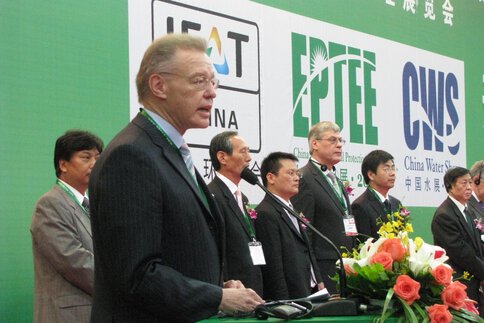
IFAT China cooperates with the “EPTEE & CWS Show for Water, Air, Waste, Energy, and Recycling,” which until this point had been the largest national environmental trade fair in China. The new title of the show is initially “IFAT CHINA + EPTEE + CWS,” which will subsequently become “IE expo China.”
2011 – Energy-efficient wastewater treatment plants
In Germany, a new funding priority for “energy-efficient wastewater treatment plants” is launched. The Federal Ministry for the Environment supports 13 innovative projects with a total of almost EUR 10 million.
2012 – Mega Cities and W2E
One of the main themes of IFAT ENTSORGA is “Waste is a raw material.” New product groups such as “secondary raw material suppliers” and “secondary raw material buyers” are introduced. The conference program covers topics such as mega cities, phosphorus recycling from sewage sludge, the Circular Economy Act, and waste-to-energy (W2E).
2013 – Lead-free pipes
- Drinking water in Germany goes lead-free: A new limit requires old lead pipes to be replaced.
- The first edition of IFAT India takes place at the Bombay Convention & Exhibition Centre (BCEC) in Mumbai.
2014 – Removal of the suffix “ENTSORGA”
After two events under the name IFAT ENTSORGA, the leading trade fair for environmental technologies returns to its original name, IFAT. Here is the logo from that time.
2015 – IFAT trade fair network continues to grow
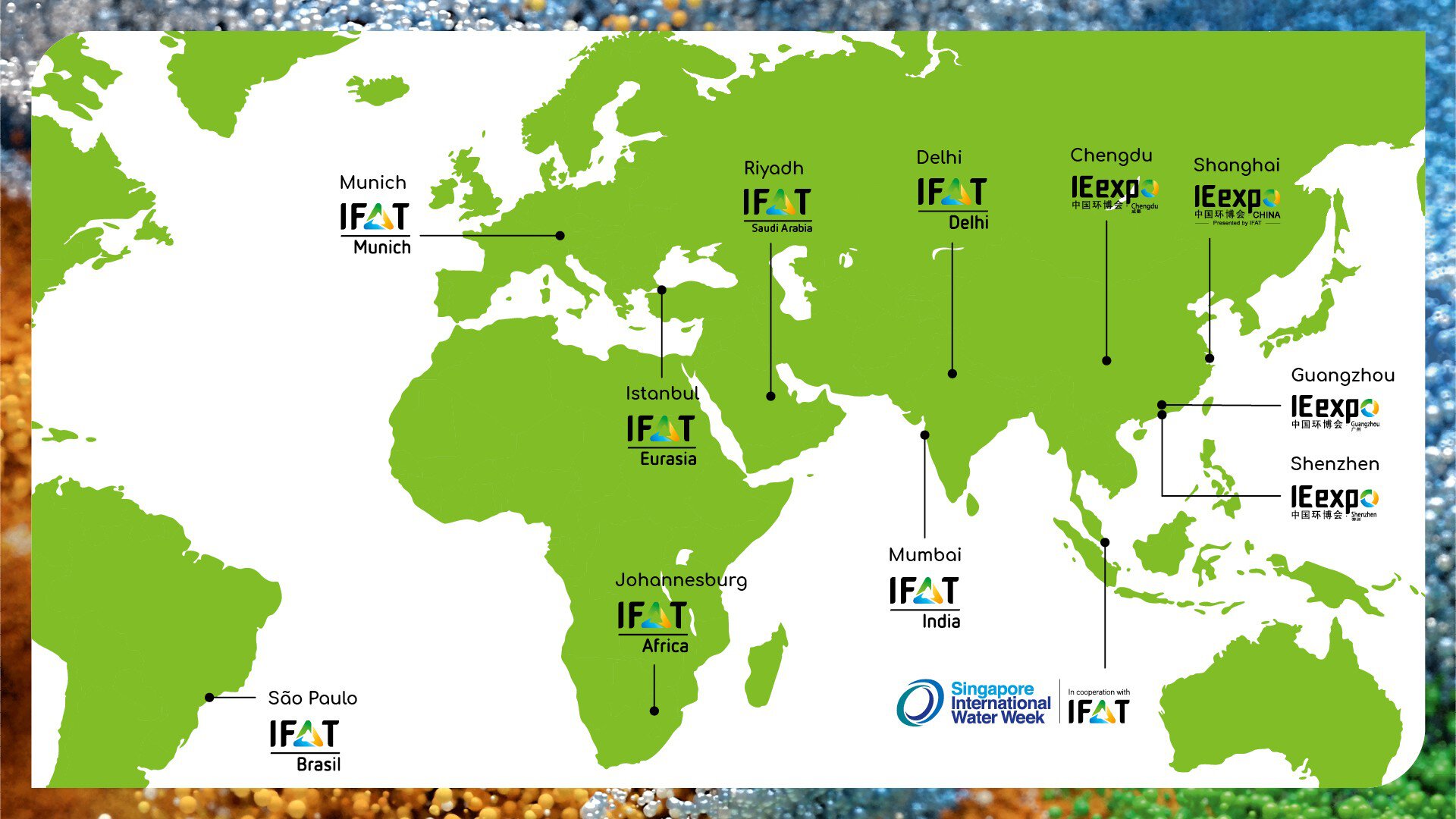
- The Guangzhou International Environmental Protection Exhibition & IE expo Innovation Conference (GIEPE) is held for the first time in southern China and will be renamed IE expo Guangzhou from 2016.
- IFAT Eurasia launches in Istanbul, Türkiye, at the interface between Europe and Asia.
- With the first IFAT Africa in Johannesburg (South Africa), the trade fair family is now also present on the African continent.
2016 – 50 years of IFAT
IFAT celebrates its 50th anniversary. Among the world firsts presented at IFAT, there is the Flygt Concertor pump system from manufacturer Xylem. The intelligent wastewater pump can automatically adapt to the respective flow conditions and has an automatic cleaning function. Thanks to the new partnership with the German Technical and Scientific Association for Gas and Water (DVGW), visitors to the trade fair can experience pipeline construction work for water networks live for the first time.
2017 – Billions in sales with environmental protection
Germany’s Federal Statistical Office estimates that companies in the manufacturing and service sectors in the country generate EUR 73.9 billion in sales of goods, construction, and services for environmental protection.
2018 – Climate-neutral waste collection
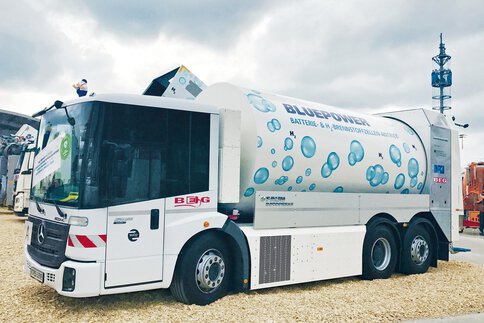
The IFAT final report lists the following key topics: water and waste 4.0, more sustainable use of resources, and more effective recycling of plastics. Above all, growing consumer awareness and demand for sustainability are strengthening the industry. Manufacturer FAUN presents Bluepower, the world’s first hydrogen-powered refuse collection vehicle, as a new product at the trade fair.
2019 – No more cappuccino in plastic cups
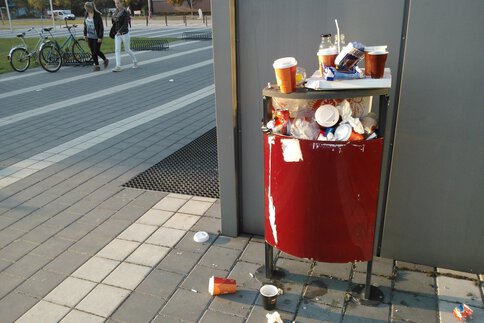
- The EU decides to ban certain single-use plastic products. The flood of waste from the many “coffee-to-go” cups comes into focus.
- Significantly higher recycling rates come into in effect in Germany as of January 1. This forces the industry to innovate in the areas of sorting facilities and chemical recycling.
- New to the IFAT trade fair network: IE expo Chengdu is presented as an environmental technology solutions platform for the western China region.
2020 – No in-person trade fair due to the pandemic
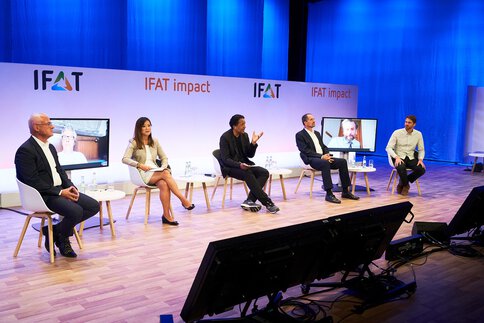
- Due to the coronavirus pandemic, IFAT is initially postponed from May to September and then canceled as an in-person trade fair. Instead, Messe München organizes a three-day digital presentation and discussion event entitled “IFAT impact Business Summit” (photo).
- The German waste management industry withstands the pressures caused by the pandemic. Federal Environment Minister Svenja Schulze says: “Waste collection and disposal companies are proving their systemic importance for our country, especially in these difficult times.”
2021 – The end of plastic straws and similar items
The EU ban on single-use plastics—such as cutlery and drinking straws—comes into force in Germany through the Single-Use Plastics Ordinance. As a result, bio-based plastics and reusable systems are increasingly developed.
2022 – Now with “Munich” in its name
- As part of its brand identity, IFAT now includes the suffix “Munich.” This is primarily to enhance international recognition and distinguish it from other IFAT offshoots around the world.
- IE expo Shenzhen is a new addition to the series of Chinese environmental trade fairs.
- The coronavirus pandemic gives new impetus to the monitoring of pathogens in wastewater. For example, a project network coordinated by the Karlsruhe Institute of Technology (KIT) starts in February with the aim of developing a wastewater-based COVID-19 early warning system. The EU funds the project with around EUR 3.7 million.
2023 – Smart sorting systems and green steel
Waste sorting plants are increasingly using neural networks and laser spectroscopy to separate plastics by type so that they can be reused for food packaging.
Singapore International Water Week Pte Ltd (SIPL) and MMI Asia Pte. Ltd., a wholly owned subsidiary of Messe München in Singapore, announce a long-term agreement to organize Singapore International Water Week (SIWW) | Water Expo.
2024 – IFAT Munich with record exhibition space
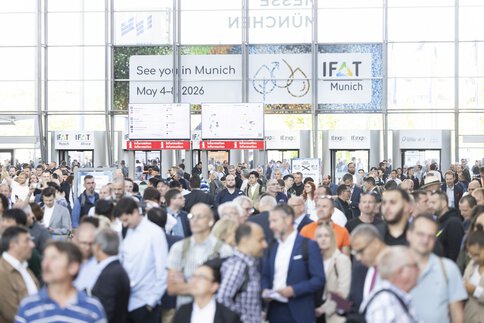
- IFAT Munich ends with top attendance: around 142,000 participants from nearly 170 countries and regions. This corresponds to the record level of 2018. The proportion of international visitors was over 50 percent, higher than ever before. With 300,000 square meters, the show is also the largest IFAT ever in terms of floor space. For the first time, there is a special area (Spotlight Area) for hydrogen in the circular economy. Digital innovations such as the use of AI and IoT to optimize water and waste management are on display.
- With IFAT Brasil in São Paulo, the IFAT cluster enters the South American market.
2025 – A thriving startup scene
There are approximately 3,000 GreenTech startups active in Germany, with one-third holding their own patents and increasingly developing hardware.
2026 – Anniversary and international growth
- In this anniversary year, more than 3,000 exhibitors from over 60 countries will be presenting their strategies and innovations at IFAT Munich from May 4 to 7.
- The international trade fair network is also continuing to grow: IFAT Saudi Arabia celebrated its premiere in Riyadh in January, while IFAT Delhi will take place for the first time in the Indian capital in April.
Stay informed!
Stay up to date with the IFAT Munich industry newsletter—covering trends, innovations, and events in the environmental technology industry.